Nicotine pouches, evidence and proportion
A critical review of the Australian Medical Association’s statement—testing its claims against the evidence hierarchy, comparative risk and the practical consequences of policy.
What this page does
The AMA raises legitimate concerns about youth access, high-strength products, misleading promotion and weak quality controls. This page asks whether its framing and preferred policy response are proportionate to the available evidence—and whether closing lawful pathways could create unintended harms.
Read the original AMA statement
For transparency, readers should review the source statement alongside this analysis.
Open the AMA media release →The central issue is not whether nicotine pouches require regulation—they do. The issue is whether the evidence supports treating them as an exceptional public-health emergency, and whether Australia can protect young people without denying adult smokers access to regulated, lower-risk alternatives.
How the evidence should be read
Long-term epidemiology for nicotine pouches remains limited. That uncertainty matters. But responsible analysis also considers chemical composition, pharmacokinetics, clinical findings, real-world behaviour and evidence from related oral nicotine products. Uncertainty should narrow claims in both directions: it should prevent declarations of harmlessness, but also prevent assumptions that pouches carry risks comparable to cigarettes.
Australia’s daily smoking rate has continued to fall
Selected AIHW NDSHS data points. Daily smoking among people aged 14+ fell from 19.5% in 2001 to 5.6% in 2025. This does not eliminate concern about emerging products, but it provides essential context for claims of crisis.
Is this a “national health crisis”?
The AMA describes nicotine pouches as part of a wider “national health crisis” and calls for urgent, coordinated action.
The language of crisis should be tested against the scale and direction of the available data. The 2025 National Drug Strategy Household Survey reports that daily smoking among Australians aged 14 and over fell to 5.6%, down from 8.3% in 2022–2023 and 19.5% in 2001. Past-year use of any nicotine product also fell to a historic low of 15.2%. Nicotine pouch use was reported by 1.8% of people aged 14 and over in the past year, although use was higher among adults aged 18–24.
These figures justify monitoring, age controls and proportionate safeguards. They do not, by themselves, establish that nicotine pouches are driving a national health crisis. The principal source of tobacco-related death and disease remains combustible smoking. Public-health language should preserve that distinction so that the response matches the magnitude and nature of the risk.
“Huge doses of nicotine”: dose is not the same as harm
The AMA warns that some unapproved pouches may contain more nicotine than is absorbed from one cigarette and says they should not be presented as a healthier alternative.
Nicotine strength is relevant to dependence, adverse effects and safe product design, but nicotine dose alone is not a complete measure of health risk. The central toxicological comparator is combustion. Cigarette smoke exposes users to a complex mixture of toxic and carcinogenic substances generated by burning tobacco; nicotine pouches do not involve combustion.
A proportionate response would set enforceable limits on nicotine per pouch, require accurate labelling, child-resistant packaging, ingredient controls and adverse-event monitoring. It would not assume that every product delivering more nicotine than a single cigarette is therefore as harmful as smoking. Product strength can be regulated directly; comparative risk should be assessed across the whole exposure profile.
“Unapproved” is a regulatory status, not a scientific conclusion
The AMA repeatedly describes nicotine pouches as “unapproved” and “unproven” because no nicotine pouch is included on the Australian Register of Therapeutic Goods.
That status matters legally, but it should not be presented as a substitute for a comparative-risk assessment. “Not on the ARTG” means that a product has not been registered through Australia’s therapeutic-goods pathway. It does not, by itself, establish that the product is as hazardous as smoking or incapable of reducing harm for an adult who switches completely.
The evidence question and the regulatory-classification question are related but distinct. Australia can require evidence and quality standards without implying that absence from a pharmaceutical register is itself a toxicological verdict. A clearer public explanation would separate legal approval, cessation claims, product safety and relative risk.
The evidence hierarchy must be applied consistently
The AMA calls for action because nicotine pouches lack adequate safety data and are not proven cessation therapies.
Long-term, product-specific evidence is still developing, and uncertainty should be stated plainly. But evidence should be weighed in layers. Clinical and pharmacokinetic studies can inform nicotine delivery and short-term effects. Chemical analyses can compare toxicant profiles. Observational studies can identify patterns of switching, dual use and uptake. Evidence from related oral nicotine products can inform—but not conclusively determine—long-term expectations.
The absence of decades of epidemiology for a newer product does not mean there is no usable evidence. Nor should weaker forms of evidence be used selectively: precautionary concerns, expert opinion and projections should not automatically outweigh direct chemical, pharmacological and population data. The defensible position is calibrated uncertainty—not certainty of safety, but also not certainty of equivalence with smoking.
Relative risk cannot be omitted
The AMA emphasises addiction, youth uptake and uncertainty, but gives little attention to how nicotine pouches compare with combustible cigarettes.
A policy assessment that excludes the smoking comparator is incomplete. Nicotine pouches are not risk-free, and non-users—especially young people—should not start using them. For adults who smoke, however, the relevant question is whether complete substitution is likely to reduce exposure to the toxic products of combustion.
European risk assessments and peer-reviewed toxicological studies generally identify substantially fewer and lower levels of many harmful constituents in nicotine pouches than in cigarettes, while also identifying risks from nicotine exposure and product variability. This supports regulated risk differentiation, not unrestricted sale. Public communication should be capable of saying both things at once: pouches carry risks, and smoking is far more dangerous.
Youth protection needs the right baseline
The AMA highlights that 8.4% of 18–24-year-olds reported past-year nicotine pouch use and warns that a fragmenting nicotine market may undermine tobacco-control gains.
The 18–24 result warrants attention, particularly because first-time measurement limits trend analysis. But 18–24-year-olds are adults, and past-year use is not the same as daily or dependent use. The same survey reports that current e-cigarette use among this age group fell from 20.6% to 14.0%, current smoking fell to 6.1%, and overall past-year nicotine use fell from 30.7% to 24.4%.
This does not remove concern about youth or young-adult uptake. It does show why product-specific prevalence should be interpreted alongside total nicotine use, frequency of use and displacement of smoking. The aim should be to prevent initiation among non-users while preserving incentives for smokers to move away from combustion.
Closing legal pathways may create practical harms
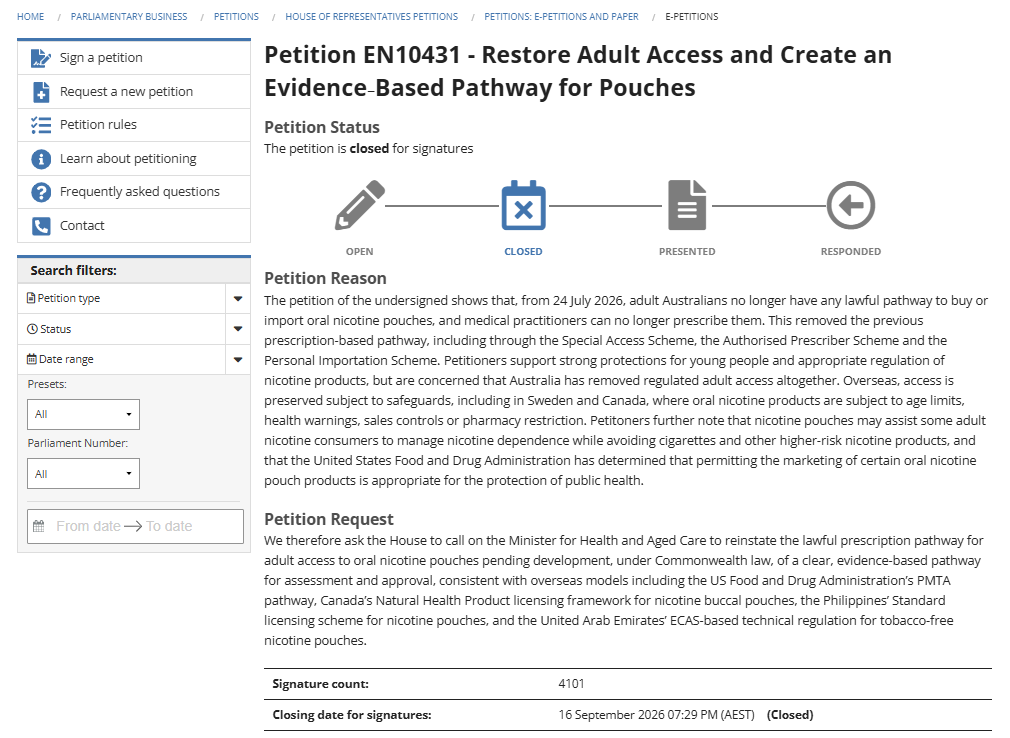
The policy supported by the AMA would prevent access through pathways including the Special Access Scheme and Authorised Prescriber Scheme.
Removing physician-mediated access may reduce one route to unapproved products, but policy analysis should also examine what happens next. Demand may not disappear. Some consumers may return to cigarettes, purchase through informal sellers or import products from sources without reliable strength limits, ingredient controls or child-resistant packaging.
These outcomes are not inevitable, but they are foreseeable enough to require an impact assessment. A policy that closes regulated or supervised routes while leaving cigarettes widely available risks preserving the easiest access to the highest-risk nicotine product. Enforcement should be paired with a lawful, standards-based pathway if the objective is both consumer protection and smoking harm reduction.
Marketing controls and truthful risk communication are different issues
The AMA argues that nicotine pouches should not be promoted as a “healthier alternative” and calls for stronger action against online and social-media promotion.
Youth-targeted marketing, misleading therapeutic claims and irresponsible promotion should be prohibited. That does not require suppressing every scientifically supportable comparison with smoking. Consumers can be told that a product is not harmless, is addictive, is not approved as a cessation medicine, and is likely to expose a complete switcher to substantially fewer combustion-related toxicants than cigarettes.
The distinction matters. Marketing regulation should control audience, placement, descriptors, claims and evidence standards. It should not force all nicotine products into a single undifferentiated risk category. Accurate comparative information can support informed adult choice while strict controls protect young people.
What a proportionate policy could look like
The AMA calls for stronger enforcement, national retail licensing, platform cooperation and regulations that cover emerging nicotine products.
Several of those measures are compatible with a risk-based framework. The question is whether enforcement is combined with a viable legal market for compliant adult products.
A proportionate model would maintain strict age restrictions and meaningful penalties for sales to minors; prohibit youth-oriented branding and unsupported health claims; set maximum nicotine content per pouch; require ingredient disclosure, contaminant limits, prominent warnings and child-resistant packaging; license importers and retailers; collect adverse-event and market data; and periodically review population outcomes.
This approach would not treat nicotine pouches as harmless or as approved medicines. It would regulate them according to their actual characteristics, preserve the cigarette as the highest-risk comparator and reduce incentives for illicit supply.
A proportionate, risk-based framework
Strict age verification, retailer accountability and controls on youth-oriented promotion.
Nicotine limits, ingredient disclosure, contaminant controls, clear warnings and child-resistant packaging.
A lawful pathway for compliant products intended for adults who would otherwise continue smoking.
Track initiation, switching, dual use, adverse events, illicit supply and smoking prevalence.
State clearly that pouches are not harmless while preserving the critical distinction from combustion.
Use transparent evidence thresholds and periodic review rather than permanent rules built on early uncertainty.
Regulate the risk. Do not protect the cigarette.
Australia can strengthen youth protection and product safety without treating every nicotine product as though it carries the harms of smoking.
Sources and supporting evidence
- Australian Medical Association. AMA welcomes announcement on nicotine pouches but calls for more action.
- Australian Institute of Health and Welfare. National Drug Strategy Household Survey 2025: Tobacco, e-cigarettes and other nicotine insights.
- Australian Government Department of Health, Disability and Ageing. Australia's smoking rates declining.
- German Federal Institute for Risk Assessment (BfR). Health risk assessment of nicotine pouches.
- Peer-reviewed review. Nicotine pouches: a review for the dental team.
- Peer-reviewed toxicological study. Comparative toxicology evidence concerning nicotine pouches.