Australia's Nicotine-Pouch Restrictions: The Missing Counterfactual
An Australian Consumers Alliance policy response to the TGA's decision, University of Queensland literature review and targeted consultation
Australia has closed existing consumer access pathways for nicotine pouches, citing concerns about safety, therapeutic effectiveness and youth uptake. These concerns deserve serious attention. Yet they leave an important question unanswered: will removing access improve public health, or could a regulated alternative produce better outcomes?
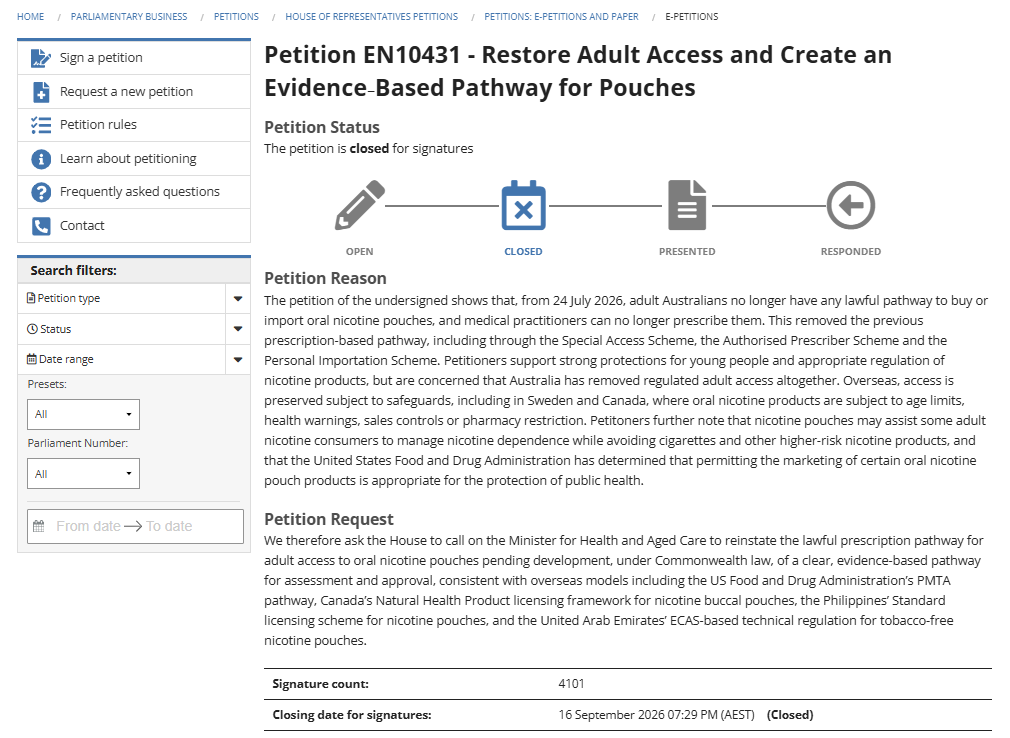
From 24 July 2026, the Therapeutic Goods Administration (TGA) removed access through personal importation, the Special Access Scheme, the Authorised Prescriber Scheme and pharmacy compounding. Formal product registration remains possible, but no nicotine pouch is currently included on the Australian Register of Therapeutic Goods.
The decision was informed by a University of Queensland literature review and targeted stakeholder consultation, subsequently released under Freedom of Information. These documents identify genuine risks and gaps in the evidence. What they do not establish is that closing existing access pathways will deliver better public-health outcomes than appropriately regulated adult access.
For the Australian Consumers Alliance (ACA), this is the central issue. A policy must be judged against what would realistically happen in its absence, including the choices consumers make when their preferred product is no longer available.
Three Questions the TGA Must Distinguish
The regulatory debate combines three questions that require different evidence. Are nicotine pouches sufficiently safe and effective to be approved as smoking-cessation medicines? Can switching completely from cigarettes to nicotine pouches reduce exposure to harmful substances? And would regulated adult access produce better population-health outcomes than restricting supply?
The University of Queensland review concludes that current evidence does not support nicotine pouches as smoking-cessation aids when compared with approved nicotine replacement therapies. It also identifies uncertainties about long-term health effects, inconsistent product composition and potential risks to young people.
These findings justify caution, product standards and restrictions on unsupported therapeutic claims. They do not establish that removing consumer access is the best public-health intervention.
An adult using nicotine pouches to avoid smoking may have a different objective from someone seeking complete nicotine abstinence. Evidence of reduced toxicant exposure when cigarettes are fully replaced is relevant to that distinction, although it cannot establish long-term health outcomes or population-wide benefits.
The accompanying policy analysis identifies research supporting the potential for lower toxicant exposure relative to smoking, while acknowledging uncertainty about sustained substitution, dual use and initiation among non-users.
The relevant question is therefore what nicotine pouches replace, who uses them and what happens when they are unavailable.
What the University of Queensland Review and Consultation Actually Show
The University of Queensland review identifies legitimate concerns about product quality, nicotine content, contaminants, marketing and youth experimentation. These findings support enforceable manufacturing standards, accurate labelling, age restrictions and independent monitoring.
They also raise a question about regulatory proportionality. Variation in product quality provides a reason to assess and control individual products. It does not establish that no nicotine pouch could meet appropriate safety and manufacturing requirements.
The review acknowledges that some consumers use nicotine pouches to manage cravings and substitute for other tobacco or nicotine products. This does not prove therapeutic effectiveness, but it establishes that consumer behaviour is relevant to evaluating the consequences of restricted access.
The TGA's targeted consultation provides further insight. Conducted between 27 March and 15 April 2026, it received 24 submissions. According to the consultation analysis released under FOI, 23 respondents supported the proposed amendments and one did not. On the likely overall impact, 20 anticipated a positive outcome, three expressed mixed views and one was unsure.
This was substantial support among the health organisations, government agencies and relevant experts consulted. Respondents raised concerns about insufficient cessation evidence, youth nicotine dependence, social-media promotion and the potential misuse of existing regulatory pathways.
Those concerns should be acknowledged. However, the consultation analysis also records concerns that removing access could disadvantage highly nicotine-dependent smokers who had not responded to existing treatments and could contribute to illicit-market activity.
That dissenting perspective raises an important policy question. If adults who previously used nicotine pouches return to cigarettes or obtain products from unregulated suppliers, how would those outcomes affect the balance of benefits and harms?
The consultation does not establish that these consequences will occur. Equally, strong stakeholder support does not demonstrate that they will not.
A targeted consultation can inform regulatory decisions, but it cannot substitute for evidence of what happens after a policy is implemented.
The Missing Counterfactual: What Happens When Access Disappears?
Removing access to nicotine pouches does not necessarily remove nicotine dependence or consumer demand.
Some adults may stop using nicotine, while others may move to approved cessation therapies. Some could continue smoking, return to cigarettes or seek pouches through illicit suppliers. These possibilities should be investigated rather than assumed.
The University of Queensland review was completed before the July 2026 restrictions took effect. It therefore cannot demonstrate the consequences of closing those access pathways.
The review also reports that nicotine pouches were already reaching young Australians despite restrictions on retail sales and marketing. This highlights the importance of enforcement and raises questions about whether further restrictions on lawful access will eliminate supply.
ACA does not claim that the policy will necessarily increase smoking relapse or illicit purchasing. It argues that these outcomes are relevant to the public-health assessment and should be measured.
Consumer experience is important here. Adults who report using nicotine pouches to manage cravings or remain smoke-free cannot establish clinical efficacy through personal testimony alone. Nevertheless, their experiences can identify unmet needs and help researchers understand how people respond when access changes.
Approved nicotine replacement therapies remain important, but their availability does not establish that every consumer finds them acceptable or sustainable.
An independent evaluation should therefore examine smoking histories, complete substitution, dual use, relapse, illicit purchasing, youth initiation and adverse events. Without this evidence, the relative merits of restriction and regulated access remain unresolved.
Why Regulated Access Deserves Serious Consideration
ACA does not advocate unrestricted nicotine-pouch sales or unsupported therapeutic claims. It supports a consumer-centred, risk-proportionate framework that protects young people while recognising the needs of adults who already use nicotine.
A regulated alternative could require product-specific quality assessment, verified nicotine content, contaminant limits, accurate labelling, child-resistant packaging, effective age verification and restrictions on youth-directed marketing. Therapeutic claims would remain subject to appropriate evidence and authorisation.
Such an approach would not eliminate risk or guarantee better outcomes. It would, however, provide a meaningful alternative against which the current restrictions could be evaluated.
Australia should explain why enforceable product standards and controlled adult access would be insufficient before treating the closure of existing pathways as the preferred public-health response.
The University of Queensland review provides reasons for caution. The consultation demonstrates substantial stakeholder support for tighter restrictions. Neither establishes that removing access produces better outcomes than regulating it.
ACA therefore calls for independent evaluation of the July 2026 restrictions, meaningful consumer participation and an explicit comparison with feasible regulated-access alternatives.
The ultimate test should be whether Australia's approach reduces smoking-related harm, protects young people and improves consumer safety in practice.
The question remains: has Australia demonstrated that removing lawful access is better for public health than regulating it?
Until that comparison is made, the central counterfactual remains unanswered.
Sources: University of Queensland, Nicotine Pouches Literature Review (30 June 2026); TGA, Consultation Analysis: Regulation of Nicotine Pouches (FOI 27-3674); The TGA Case for Banning Nicotine Pouches Confuses Three Different Questions; and ACA, Nicotine Pouches and the Management of Nicotine Dependence.