Australia's Nicotine Pouch Policy: The Questions That Remain Unanswered
By Shem Baldeosingh
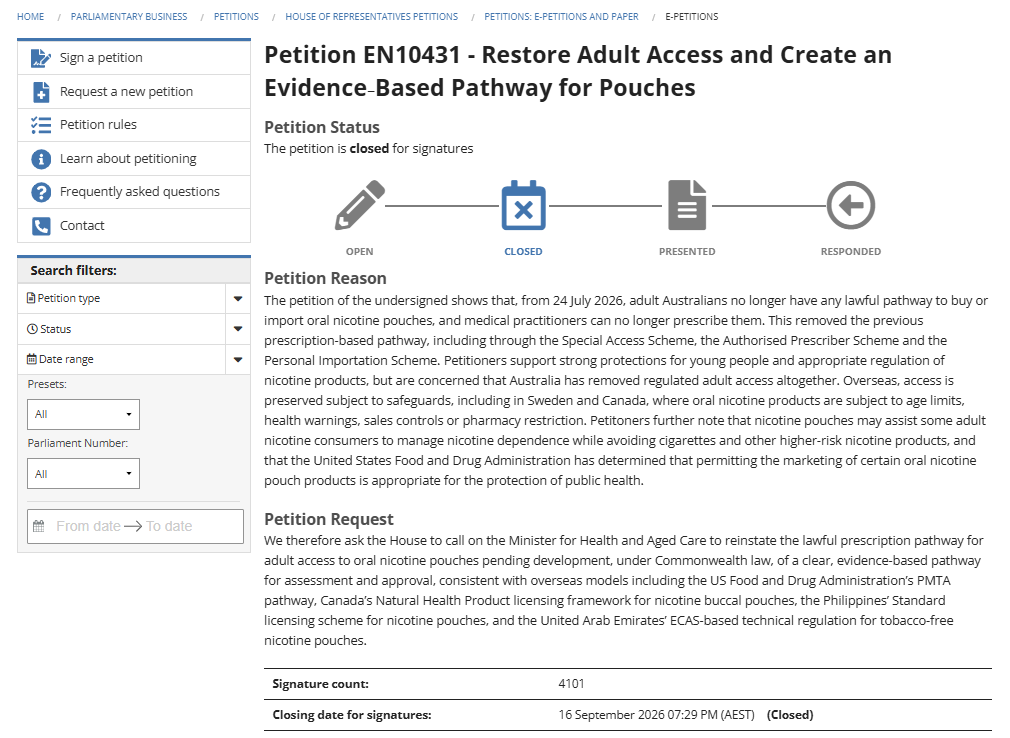
Thousands of Australians are still waiting for Health Minister Mark Butler to respond to our parliamentary e-petition on nicotine pouches. Meanwhile, the Government has outlined its reasons for restricting access to these products, citing nicotine dependence, youth protection, product safety and limited evidence supporting their use as smoking-cessation treatments.
These are legitimate public-health concerns. What remains unclear is why closing access pathways is considered preferable to tightly regulated adult access, and whether the Government has adequately assessed the alternatives and their likely consequences.
Why Australia Is Taking This Approach
The Therapeutic Goods Administration (TGA) approaches nicotine pouches through Australia's medicines framework. It highlights limited evidence for smoking cessation, uncertainty about long-term health effects, product-quality concerns and the availability of approved treatments. From 24 July 2026, Australia closed access through personal importation, the Special Access Scheme, the Authorised Prescriber Scheme and compounding.
Other jurisdictions have adopted different approaches.
United States
Evaluates specified nicotine pouches through a tobacco-product authorisation process that considers potential benefits to existing adult users alongside risks to young people.
Sweden
Permits tobacco-free nicotine products under a dedicated framework covering product notification, age restrictions and sales requirements.
Neither approach removes the risks associated with nicotine. They do, however, demonstrate that governments can pursue public-health protections while allowing regulated adult access.
Where the Government's Argument Falls Short
1Different Regulatory Approaches Deserve a Substantive Comparison
Acknowledging that countries have different policies does not explain why Australia's approach is expected to deliver better outcomes.
In January 2025, the US Food and Drug Administration (FDA) authorised 20 specific ZYN nicotine pouch products after finding substantially lower levels of harmful constituents than cigarettes and most smokeless tobacco products. Its assessment concluded that the potential benefits for adult users outweighed the population-level risks, including risks to young people.
This was a product-specific decision, not an endorsement of all nicotine pouches. Nevertheless, it provides a relevant regulatory comparison. Australia should explain which findings it accepts or disputes and why a comparable controlled-access framework was considered unsuitable.
2Limited Therapeutic Evidence Does Not Rule Out Potential Harm Reduction
The TGA's concerns about insufficient smoking-cessation evidence are valid. A 2025 Cochrane review found limited evidence concerning nicotine pouches for smoking cessation or reduction, with low or very low confidence in the findings. Nicotine pouches therefore cannot currently be presented as established cessation treatments.
However, insufficient evidence of therapeutic efficacy is not proof of ineffectiveness. Nor does it answer whether an adult who switches completely from cigarettes to a non-combustible product could reduce exposure to harmful substances.
Reduced exposure does not establish long-term safety or prove cessation effectiveness. It is nevertheless relevant to assessing potential public-health benefits. The Government should explain why limited therapeutic evidence also justifies closing access for adult substitution rather than considering a separately regulated consumer-product pathway.
3Youth Protection Does Not Automatically Require Closing Adult Access
Preventing nicotine initiation among young people must remain a priority. Nicotine is addictive, and adolescent exposure raises legitimate concerns about dependence and brain development.
The question is whether these risks require closing adult access pathways or whether enforceable safeguards could adequately address them.
Sweden's framework includes age verification, retailer notification, self-monitoring requirements and product-information obligations for manufacturers and importers. These measures do not eliminate youth-use risks, but they demonstrate that adult access can coexist with regulatory controls.
Australia should explain why comparable age restrictions, marketing controls, product standards and enforcement measures were considered insufficient.
4The Medicines Framework Does Not Settle Consumer Regulation
The Government is justified in preventing nicotine pouches from being marketed as approved medicines without supporting evidence. However, the absence of therapeutic approval does not necessarily establish that a separate regulated consumer-product category is inappropriate.
The FDA has authorised specific nicotine pouches through a tobacco-product pathway, while Sweden regulates tobacco-free nicotine products under dedicated legislation.
Neither system guarantees safety. Both demonstrate that medicinal approval and regulated consumer access are distinct questions.
A fuller Australian explanation would identify whether alternative regulatory classifications were considered, what concerns were identified and why the existing medicines framework was preferred.
5Product-Quality Concerns Should Be Considered Alongside Product Standards
The TGA has identified concerns about inconsistent nicotine content, contamination and misleading labelling. These are legitimate risks that require effective oversight.
However, they also raise questions about whether mandatory testing, manufacturing controls, accurate labelling and verified ingredient information could address some of those risks.
Sweden's regulatory requirements include information on ingredients, toxicological characteristics, nicotine delivery and production processes.
The relevant comparison is therefore between restricting access and imposing enforceable standards on compliant products. If the Government concluded that such standards would be inadequate, the reasons should be explained.
6Stronger Enforcement Is Not the Same as Better Public-Health Outcomes
The TGA argues that the changes strengthen its ability to address unlawful importation, advertising and supply. Effective enforcement is important, but stronger powers alone do not demonstrate that the policy will improve overall public-health outcomes.
Closing access pathways may reduce some forms of supply. Its effects on demand and consumer behaviour remain uncertain. Some adults may stop using nicotine, while others may seek unregulated products or return to cigarettes.
These are possibilities, not established outcomes. The Government should explain its assumptions and monitoring plans, including how it will assess youth uptake, adult smoking behaviour, unlawful supply and unintended consequences.
Australians Deserve Clear Answers
Australia's progress in reducing smoking deserves recognition. However, describing its reforms as “world leading” and warning that new nicotine products could undermine progress does not establish that closing nicotine-pouch access pathways is the most effective response.
The Government should publish the evidence, alternatives and assumptions underpinning its decision, including its assessment of youth initiation, adult substitution and unintended consequences. The effectiveness of the policy should be judged by measurable outcomes rather than its stated intentions.
For Those Who Supported Our Petition
The questions remain straightforward.
- Why was tightly regulated adult access rejected?
- What evidence supports the chosen restrictions?
- How will their effectiveness be assessed?
As we await Minister Butler's response, Australians deserve a clear explanation of the reasoning behind these restrictions.
Good public-health policy requires clear justification, proportionate measures and outcomes that can be independently assessed.