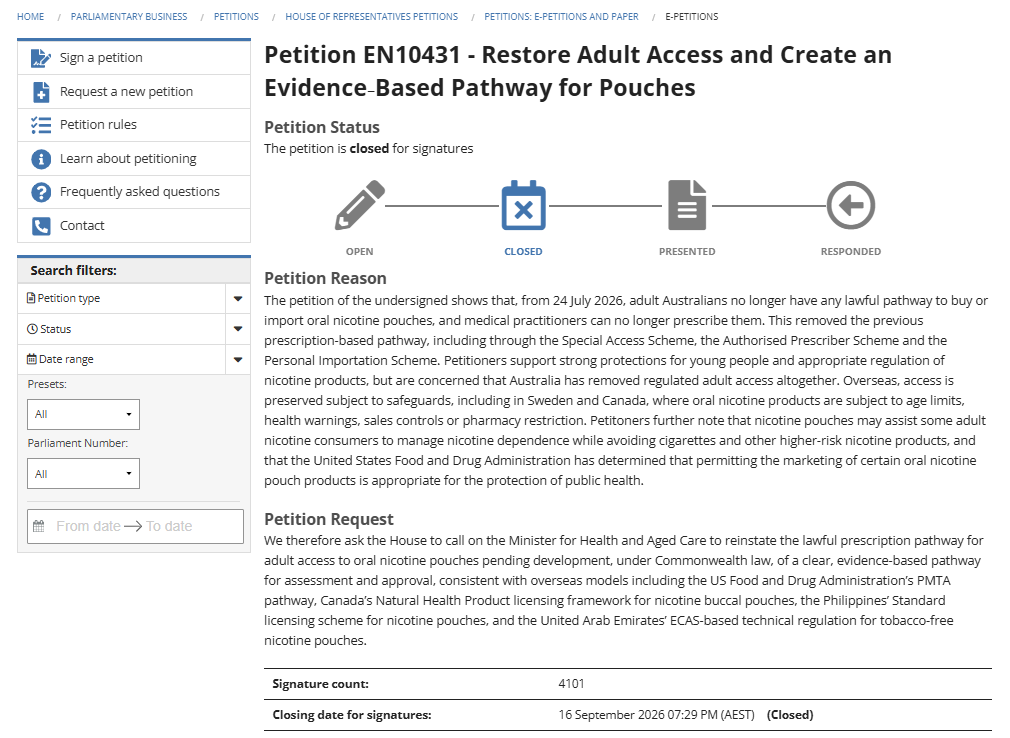
Australia Needs Better Nicotine Policy - Not More Prohibition
As Australian consumers, we want policies that genuinely protect public health. We support strong action to prevent young people from accessing nicotine products, robust product standards, and effective enforcement against illegal sellers.
But after watching the recent 7 News report on nicotine pouches, we’re left asking a simple question: Is Australia’s current approach actually working?
The report highlights products being sold through illicit channels and, in some cases, finding their way into schools. If that’s happening, it points to a failure of enforcement—not simply a lack of regulation. Expanding prohibitions without addressing enforcement capacity risks making the problem worse rather than better.
One comment in the report deserves particular attention: that Australia’s laws are deliberately broad enough to “capture whatever comes next.”
That should concern every consumer.
Good regulation should be evidence-based, proportionate, and responsive to innovation. It should assess new products according to their risks and benefits, not prohibit them before they have even been properly evaluated. When legislation is written to automatically capture future products, it risks discouraging innovation and preventing regulators from making balanced, science-based decisions.
We also repeatedly hear the argument that “we don’t know if they’re safe.”
That’s true—but uncertainty should be the beginning of the regulatory process, not the end of it.
Across many other consumer sectors, uncertainty is managed through clear assessment pathways, product standards, ingredient disclosure, manufacturing requirements, toxicological review, and ongoing post-market surveillance. If more evidence is needed, the answer is to define how that evidence will be assessed—not to eliminate every legal pathway before the assessment even begins.
The current policy also raises another important question.
If legal access disappears while consumer demand remains, where do people go?
Australia has already experienced the rapid growth of illicit markets for nicotine products. Removing regulated pathways without addressing the underlying demand is unlikely to eliminate the market. Instead, it risks pushing more consumers towards products that have no quality standards, no ingredient oversight, and no meaningful consumer protections.
As consumers, we’re not asking for an unregulated market.
We’re asking for a regulated one.
We want products that meet clear safety and quality standards. We want strong penalties for those who sell to minors. We want effective enforcement against illicit operators. And we want policymakers to distinguish between the risks posed by combustible cigarettes and those presented by smoke-free alternatives, rather than treating every nicotine product as though it carries the same level of harm.
Australia has some of the lowest smoking rates in the world, but it also faces a growing illicit nicotine market. That should prompt a serious conversation about whether current policies are achieving their intended outcomes.
The goal should not simply be to prohibit products. It should be to reduce smoking, protect young people, disrupt illicit trade, and give Australian consumers access to a regulatory system that is transparent, evidence-based, and proportionate.
That is the conversation we believe Australia should be having.